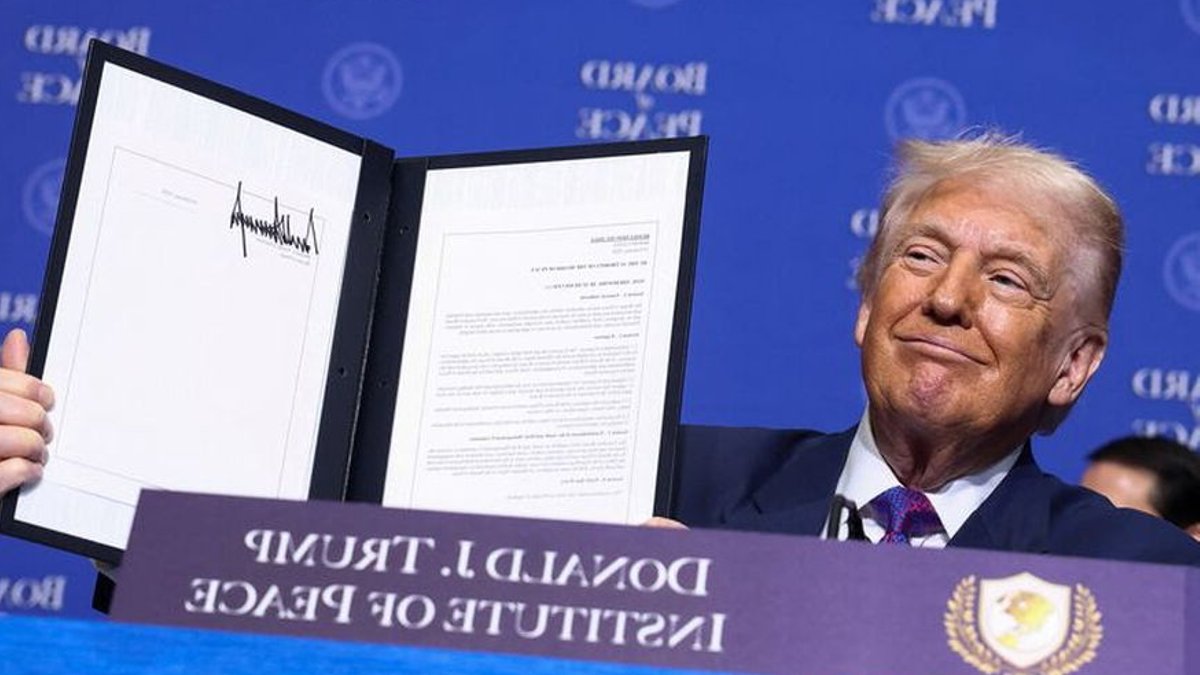
President Donald Trump said Thursday his self‑styled Board of Peace had reached a deal that would disarm Hamas and other armed groups in Gaza and see Israeli forces pull back from the territory.
Trump describes the deal as historic
The president called the agreement “historic” and said it would be rolled out in phases. Israeli troops, which have controlled about two‑thirds of Gaza since late April, would begin withdrawing as each disarmament step is verified. Trump said the board’s plan would also fund a reconstruction effort for the enclave once the fighting ends.
How the Board of Peace was formed
The concept was first announced by Trump in September, when he pledged to end the Israel‑Gaza conflict. Its charter says it will later expand its remit to other global disputes, with the president acting as chair. Traditionally, such diplomatic initiatives have been handled by the United Nations, but the board proposes a different model.
Related: Boy Rescued by Teen Lifeguard in California
Member states are limited to three‑year terms unless they pay a $1 billion fee for permanent seats. In January, the White House named U.S. Secretary of State Marco Rubio, special envoy Steve Witkoff, former British Prime Minister Tony Blair and Jared Kushner to the founding Executive Board.
Over two dozen countries have signed on as founding members, including Israel, Saudi Arabia, Egypt and Qatar, which helped broker the October ceasefire. Other signatories span the Middle East and beyond, such as Bahrain, Jordan, Turkey, the United Arab Emirates, Albania, Argentina, Armenia, Azerbaijan, Belarus, Bulgaria, Cambodia, El Salvador, Hungary, Indonesia, Kazakhstan, Kosovo, Mongolia, Pakistan, Paraguay, Uzbekistan and Vietnam.
Several major powers have declined the invitation. Britain, the European Union, France, Germany, Norway and Sweden have all said they will not join. Canada’s invitation was withdrawn after President Trump objected to Prime Minister Mark Carney’s speech in Davos. Brazil and Mexico rejected the board, citing the absence of a Palestinian representative. The Vatican, China and Russia have also stayed out, arguing that crisis management should remain under United Nations oversight.
The United Nations Security Council passed a U.S.–drafted resolution in November that recognized the board as a temporary administration to coordinate funding for Gaza’s redevelopment. The resolution authorized a short‑term International Stabilization Force for Gaza, limited to the territory and to 2027. The board must report its progress to the 15‑member council every six months. China and Russia abstained, saying the resolution did not clarify the UN’s role.
Related: Kodiak group helps island families in need
Under its charter, the board will carry out “peace‑building functions in accordance with international law.” Trump, as chairman, holds extensive executive power, including a veto over decisions and the ability to remove members, though some constraints are noted in the charter.
Critics have raised concerns that the effort resembles a colonial‑style structure, especially since it lacks a Palestinian voice. Human‑rights experts point to the inclusion of Tony Blair, given his role in the Iraq war, and question the participation of countries with poor human‑rights records, such as Belarus and El Salvador. The presence of Israel on a board meant to oversee Gaza’s temporary governance has also drawn criticism, as the enclave has been devastated by an Israeli assault that killed tens of thousands and displaced its entire population.
Israel maintains that its actions are self‑defense after Hamas militants killed 1,200 people and took more than 250 hostages in a 2023 attack.
U.N. Secretary‑General Antonio Guterres said in April that he was cooperating with the board on Gaza matters. That month, reporters noted the board had engaged with Dubai‑based DP World about supply‑chain and infrastructure projects in the enclave. In early July, an official announced plans for a pilot humanitarian zone for Palestinians in Gaza.
Related: Hybrid Infrastructure Supports AI Workloads Best
The board faces many challenges.
Looking at other peace‑building bodies, this effort seems unusually centralized around a single political figure, which could affect its credibility and effectiveness. The lack of representation from the Palestinians themselves may limit the board’s ability to gain local trust, a factor that has hampered similar initiatives in the past.
As of now, its legal authority beyond Gaza remains uncertain, and it is unclear how coordination with existing international mechanisms will work. The next six‑month report to the Security Council, due later this year, will likely shed more light on operational scope and the progress of the disarmament and withdrawal phases.